
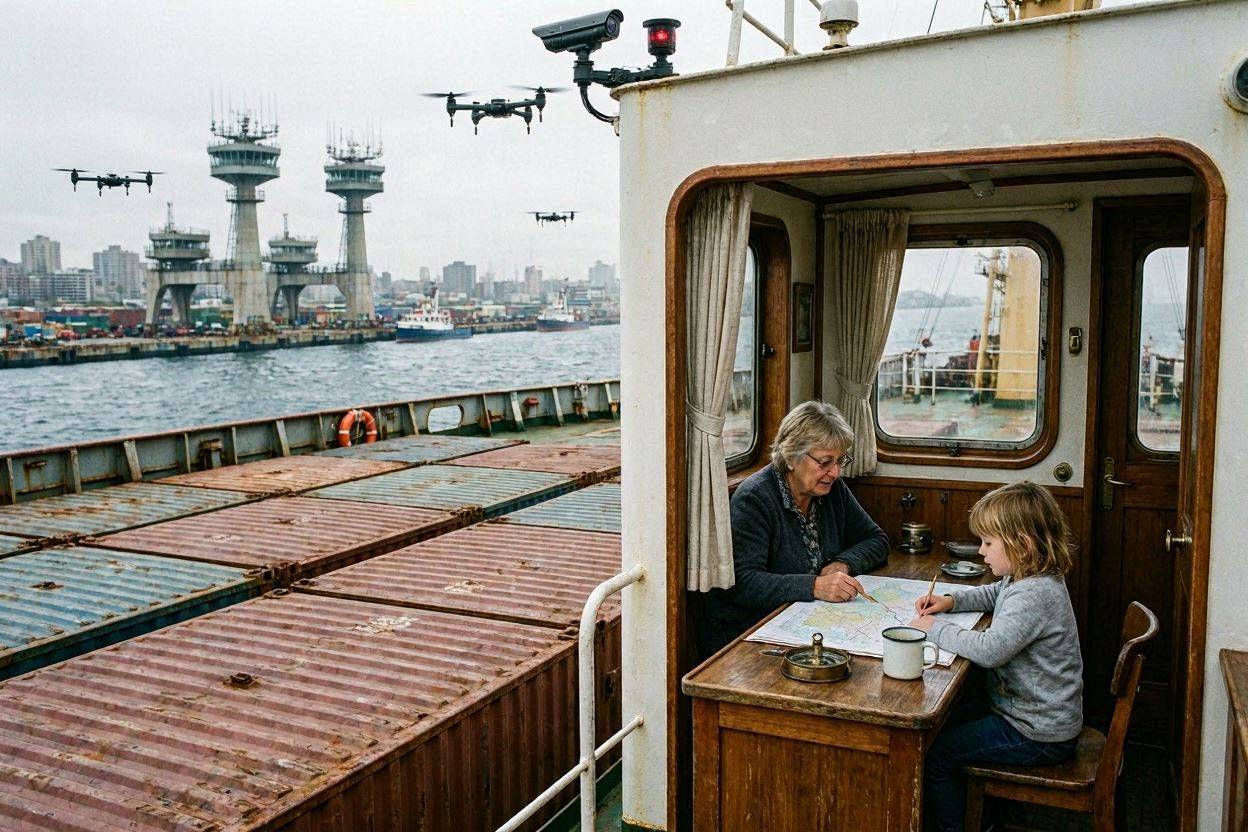
Cargo ship travel offers privacy-minded travelers a slower, quieter, and more controlled way to move between jurisdictions.
A 12-day Pacific crossing can create rare distance from digital noise, professional pressure, social obligations, airport crowds, and constant communication, giving the traveler uninterrupted time to think with clarity that is almost impossible inside the machinery of modern travel.
Freighter travel creates distance from the noise of modern movement.
For people relocating, restructuring their lives, changing tax residency, planning lawful identity transitions, or moving between jurisdictions, uninterrupted time at sea can become strategically valuable because the traveler is removed from the daily demands that usually distort long-term decision-making. The traveler is not moving through a chain of hotels, lounges, taxis, public terminals and crowded restaurants, where visibility, casual exposure, digital tracking and chance encounters are difficult to control during sensitive personal or professional transitions.
The modern travel system has become more visible than many travelers expected.
Airports have become highly structured identity environments where boarding, immigration, security, customs, passenger manifests, cameras, payment records, airline accounts, and biometric systems can create a dense record of movement. For most travelers, those systems feel normal because speed, convenience, and security are accepted as part of international mobility, but privacy-conscious travelers increasingly understand that each step creates another point of data collection. Biometric scrutiny checks have become a major concern as airports increasingly rely on facial comparison systems, automated gates, and digital identity verification workflows, making movement feel more visible than ever.
Freighter travel can support lawful relocation planning when documents are consistent.
For clients considering international relocation, lawful identity change, second citizenship, or long-term offshore planning, the method of travel can be as important as the destination, because every movement contributes to a broader identity and compliance record. A New Legal Identity or second citizenship only has practical value when used consistently, lawfully and intelligently across travel records, banking profiles, tax residency, immigration history, insurance records and personal documentation. That is why compliance-based relocation planning focuses on lawful documentation, identity continuity, jurisdictional strategy and practical travel execution rather than shortcuts, exaggerated promises or illegal claims about invisibility. For individuals exploring new legal identity planning, the travel method should support a clear and defensible record, because identity continuity depends on consistency across ports, banks, residence applications, and future immigration filings.
The controlled environment can create a rare planning window.
For someone leaving one jurisdiction and preparing for another, that planning window can be used to organize documents, review banking steps, clarify tax questions, prepare communications, study destination rules and think through the practical sequence of arrival. The ship’s isolation creates a psychological boundary between the old life and the new plan, which can help travelers process the seriousness of relocation rather than treating movement as another rushed transaction.
Life aboard a commercial freighter is practical, quiet, and operational.
Life aboard a commercial freighter is not glamorous because the ship exists to move cargo, maintain schedules, navigate safely, and support the crew’s operational responsibilities across long distances and changing weather conditions. Passengers eat in designated mess areas, follow safety instructions, respect crew schedules, avoid restricted loading zones, and understand that they are guests on a working vessel rather than customers on a leisure cruise. They may be allowed to visit the bridge, observe navigation, review route charts and watch port departures, but those privileges depend entirely on the captain, vessel rules and operational conditions. A Busan-to-Seattle journey captures that world clearly because the passenger meets the chief officer, steward, captain, cadet, and crew inside a professional maritime environment shaped by discipline rather than entertainment.
The right traveler values patience, independence, and flexibility.
Cargo ship travel is best suited to patient, independent, and flexible travelers who understand that maritime schedules can change quickly because of weather, port congestion, cargo operations, routing decisions, or shipboard requirements. It may appeal to privacy-minded professionals, writers, researchers, long-term expatriates, retirees, environmental travelers, digital minimalists and lawful relocation clients who prefer discretion, quiet and reflection over speed. It may not suit families with young children, travelers with urgent timelines, people requiring frequent medical support or anyone expecting cruise-level convenience, entertainment, service or schedule certainty.
Medical clearance and insurance are not optional details.
A commercial freighter is not a cruise ship with a medical center, a passenger care department, and multiple systems designed for large numbers of civilian guests with varying health needs. Passengers may spend days at sea without immediate access to advanced medical care, which means shipping companies often require medical clearance, proof of travel insurance, and confirmation that the traveler can safely handle shipboard conditions. A traveler who needs frequent medical attention, refrigerated medicine, mobility support, or emergency access to specialists should approach cargo ship travel with extreme caution, because the vessel’s purpose is transportation of goods rather than patient support. The U.S. State Department’s guidance on maritime travel safety reflects the broader principle that sea travel requires preparation, especially when routes involve remote waters, industrial ports, or changing security conditions.
Freighter travel requires a different relationship with time because the ship’s schedule is dictated by cargo, weather, port congestion, customs processing, mechanical needs, and operational decisions that passengers cannot control. A vessel can leave earlier than expected, depart late, wait offshore, skip a port, extend a route, or change details after the traveler has already arranged onward plans. That unpredictability makes freighter travel unsuitable for people with fixed court dates, urgent business meetings, immovable medical appointments, expiring visas, or tight onward travel commitments. The traveler must build buffer time before departure and after arrival, because the ship cannot promise the same level of schedule certainty that airlines and passenger cruise lines attempt to provide
Slow travel gives the journey strategic and psychological value.
Freighter travel fits within the broader slow-travel movement, in which travelers question whether every international journey must begin at an airport, end in speed, and treat transit as wasted time. While environmental comparisons between air travel and cargo ship travel can be complex, many travelers increasingly value slower movement, reduced consumption, and deeper engagement with the journey itself. Slow travel asks whether time at sea can become part of relocation, reflection, and planning rather than merely a delay before arrival in another jurisdiction. For privacy-minded travelers, that question becomes even more important because speed often increases visibility, while slower movement can reduce public exposure and create operational calm. On a freighter, the traveler has days to read, write, work offline, observe weather systems, watch the crew, and experience the ocean without mass tourism.
Digital detox becomes unavoidable when the signal fades.
Many travelers say they want to disconnect, but they continue carrying the same habits into every hotel, airport lounge and short-term rental because phones, work platforms and social feeds remain within reach. A freighter crossing can impose a deeper kind of disconnection because internet access may be limited, expensive, unavailable, or reserved primarily for operational communication. For some people, that creates anxiety because modern work, banking, family contact, medical communication and social reassurance often depend on the ability to remain reachable at all times.For others, the loss of constant connection becomes the most valuable part of the voyage, because the traveler finally experiences time without the reflexive pressure to answer, update, post, or monitor. That digital silence can support strategic thinking, private journaling, reading, planning, and emotional recovery from the constant alert cycle that defines modern professional life.
The privacy advantage comes from reduced exposure, not hidden movement.
Freighter travel can be ideal for lawful, low-profile and privacy-conscious travel, but it must never be misrepresented as an illegal method of disappearance, avoidance or concealment from government authority. It is not anonymous in the criminal sense, not invisible to authorities, not a way to bypass government controls and not a substitute for lawful documentation or compliance. It does not cancel immigration requirements, port inspections, customs rules, biometric obligations, visa conditions, carrier approval, medical clearance, or destination-country entry requirements. For individuals exploring lawful identity change, private relocation, second-citizenship planning, or low-profile international mobility, cargo-ship travel may be one of the most overlooked privacy tools. For people seeking anonymous living planning, the strongest approach is lawful discretion, meaning valid documents, compliant structures, accurate records, and a travel method that reduces unnecessary public exposure without creating legal risk.
The environmental argument is meaningful, but often misunderstood.
That argument may be persuasive when a passenger occupies an existing cabin on a vessel that would sail regardless, but the calculation depends on the route, ship fuel consumption, operational efficiency, port logistics, and whether passenger demand changes the service. The more defensible environmental argument is behavioral rather than absolute, because freighter travelers often move less frequently, stay longer and treat distance as something meaningful rather than something to erase through repeated flights.
Cargo ship travel changes how people see global trade.
A passenger aboard a container ship sees global trade not as an abstract economic system, but as a physical process built from steel, engines, cranes, fuel, weather, crew labor, and port schedules. Containers become more than objects because each one suggests goods, factories, consumers, supply chains, contracts, and the enormous infrastructure required to keep ordinary life functioning across continents. For professionals accustomed to digital work, the experience can be humbling because it reveals how much modern convenience depends on slow industrial movement that happens far outside public attention. The passenger watches the horizon, the loading operations, the navigation routines, and the disciplined work of crew members who keep the vessel moving safely through conditions most consumers never consider. T
. It can work well for a person relocating slowly, a writer seeking uninterrupted concentration, a privacy-minded professional seeking to reduce public exposure, or a traveler choosing a lower-stimulation route between jurisdictions. retirees, researchers, maritime enthusiasts, and long-term expatriates who value silence and unusual perspective more than convenience. The weakest case is the traveler seeking a cheap transport hack, a way around official procedures, a last-minute escape, a romantic adventure without preparation, or a cruise-like experience at cargo-ship prices. The bottom line is that freighter travel is a lawful discretion at ocean speed.
For privacy-minded travelers, the appeal is strongest when the voyage supports a broader compliance strategy that includes accurate documentation, lawful identity continuity, destination planning, insurance, immigration status, and realistic timing. For burned-out professionals and slow-travel advocates, the appeal is equally strong because the freighter turns transit into a period of recovery, perspective, and deliberate separation from digital acceleration.