
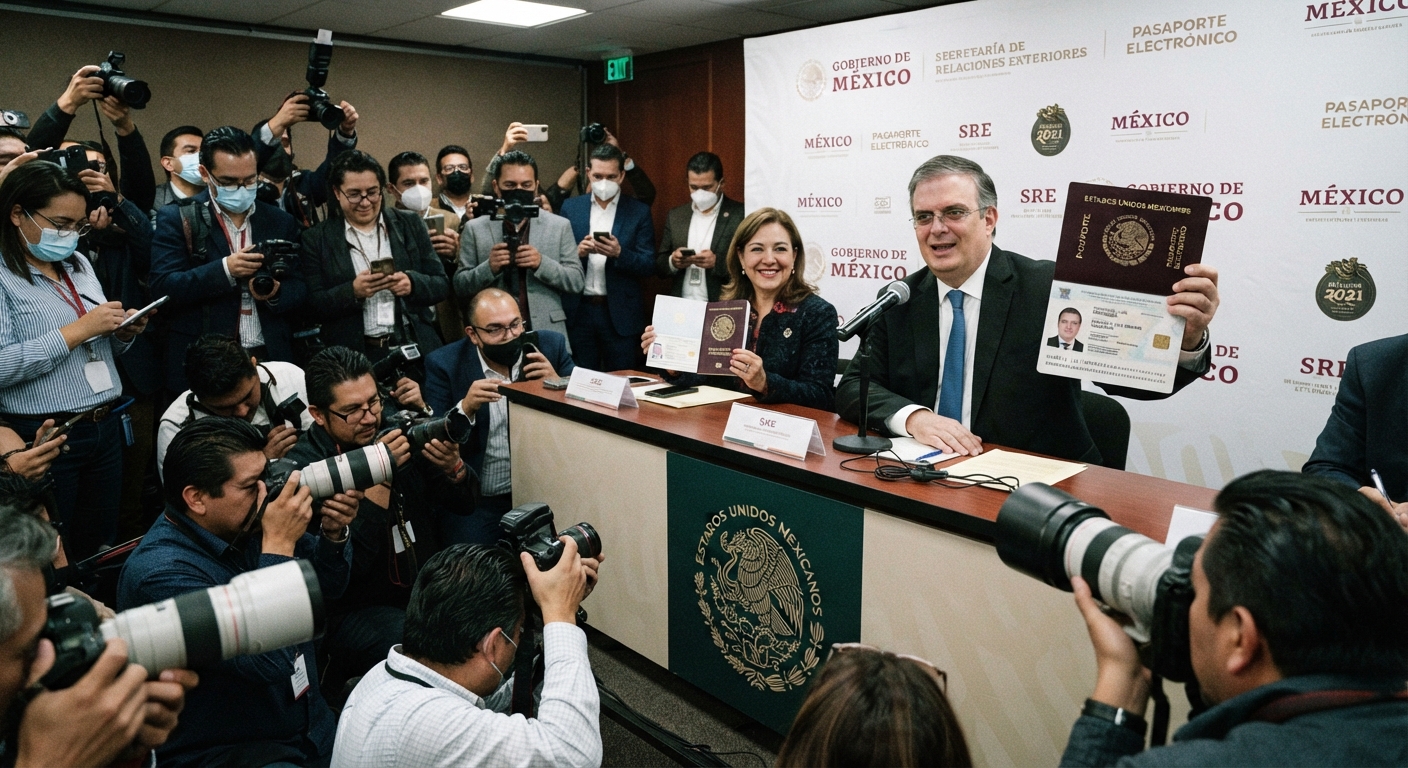
Mexico’s electronic passport places photographs and identifying Information about parents or legal guardians inside children’s travel documents, giving border officials an additional verification tool while preserving the need for appropriate consent, supporting records, and individual assessment.
Mexico introduced a distinctive child Protection feature when it launched its electronic passport in October 2021, incorporating Information and photographs of parents or legal guardians into passports issued to minors to support Identification during international travel.
The change brought family Identification into the passport booklet itself, allowing an inspecting officer to consult Information about the responsible adults alongside the child’s travel document when assessing the circumstances of an international journey.
Although descriptions of the initiative sometimes call Mexico the first country worldwide to adopt this approach, the foreign ministry’s launch announcement establishes a narrower milestone, describing the inclusion of this Information as an innovation in Mexican official documentation.
That distinction matters because the feature represents a documented improvement in Mexican passport design. At the same time, the broader claim of worldwide precedence requires comparative historical evidence that the available official announcement does not provide.
How Mexico Added Parents’ Photos to Children’s Passports
Mexico began issuing its new electronic passport on October 5, 2021, combining a polycarbonate data page and electronic chip with an additional feature for children: color Information identifying the parents or guardians within the booklet.
The foreign ministry placed that additional Information on the first page, a key distinction from descriptions that suggest all parental photographs appear directly on the child’s main polycarbonate biographical page alongside the principal identity fields.
For families examining a Mexican passport for minors, the practical significance is having an official visual reference during inspection, especially when an officer needs to understand the relationship between a child and an accompanying adult.
The booklet therefore gives officials another source of Information to compare with the adults’ Identification and any supporting records. However, those photographs cannot, on their own, answer every question about the legality of a particular trip.
Why Parental Photographs Matter at the Border
A child’s passport primarily establishes the identity and nationality of its holder. At the same time, a border officer assessing travel circumstances may also need to determine who accompanies that child and what relationship the adult claims to have.
Parental photographs can help officials examine that second question by providing an additional visual reference, especially when names alone leave uncertainty or when a young child cannot clearly explain their relationship with an accompanying adult.
In April 2024, NBC Bay Area’s reporting on Mexico’s passport security feature highlighted the inclusion of parents’ photographs as a measure intended to protect children against human trafficking, bringing additional public attention to the design.
The reasonable inference is that readily available family Identification can support an officer’s examination, but any claim that it consistently shortens processing times or prevents a particular number of crimes would require separate operational evidence.
Child Protection Requires More Than a Photograph
The security value of parental photographs depends on how officials use them, because matching an adult to an Image can support Identification without establishing that the adult’s intentions, travel arrangements or conduct protect the child.
An inspecting officer must therefore avoid treating a recognizable parent as an automatic assurance of safety, particularly because family relationships and exploitation are not mutually exclusive and a genuine identity document cannot reveal every underlying circumstance.
The State Department’s reporting on trafficking in Mexico has described situations involving complicity by parents or other relatives, underscoring why identifying a family connection cannot substitute for assessing potential exploitation and the child’s wider circumstances.
For the same reason, a responsible assessment of Mexico’s passport innovation should distinguish its intended protective function from measurable outcomes, rather than presenting the existence of a photograph as proof that trafficking or unauthorized removal has become impossible.
Passport Consent and Travel Consent Serve Different Purposes
Mexican authorities generally require consent from those exercising parental authority or legal guardianship before issuing a passport to a minor, subject to the applicable rules and supporting documentation for the child’s particular family circumstances.
The Secretariat of Foreign Affairs describes the consent requirement inclusively, recognizing different parental arrangements and guardianship situations rather than assuming that every Application involves a mother and father who can attend an appointment together.
However, agreement to obtain a passport concerns issuing an identity and travel document. At the same time, permission for a specific journey may involve separate questions about destination, timing, accompanying adults, and applicable custody arrangements.
Families should avoid interpreting the completed passport as permanent approval for every future trip, especially if circumstances change after issuance or a court order places conditions on international travel involving the child.
What the OP-7 Authorization Actually Does: The OP-7 process lets a parent who cannot attend the child’s passport appointment at the same location provide authorization through the appropriate Mexican passport office or consulate, helping families manage appointments across locations.
The Mexican Consulate in San Diego explains that a parent in Mexico can provide authorization at an appropriate foreign ministry passport office. In contrast, a parent elsewhere can use the relevant Mexican consular office for that purpose.
Its published guidance also states that the authorization must take effect within 90 calendar days after the parent expresses consent. Hence, coordinating appointments is important when the child and authorizing adult complete their respective steps separately.
Families should confirm the receiving office, required Identification, and scheduling arrangements before proceeding, since the remote authorization process facilitates passport issuance and should not be confused with a separate permission document for an international journey.
Why Supporting Travel Documents Still Matter
Parents’ photographs inside a Mexican child’s passport offer useful context. Still, families should check whether their itinerary requires a birth certificate, consent letter, guardianship record, or other evidence relevant to the journey.
The State Department’s guidance on international travel with minors advises travelers to carry evidence of their legal relationship to each child. It explains that some countries require consent from a parent who is not traveling.
Those requirements vary by jurisdiction and circumstance, so a family should review the rules governing departure, transit, and arrival rather than assuming one country’s passport design satisfies every authority along the route.
A child traveling with grandparents, another relative, a school group, or an unrelated adult may raise different documentation questions than a child traveling with both parents, even when the same valid passport accompanies the journey.
Mexico’s SAM Procedure Is Separate From Passport Issuance
Mexican consular guidance identifies the Salida de Menores, or SAM, procedure for certain minors leaving Mexico alone or with a third party, while specifying exceptions for travel accompanied by parents or legal guardians.
Because the applicable rules depend on factors including nationality, immigration status, and who accompanies the child, families should seek guidance for their specific circumstances rather than assuming every minor leaving Mexico needs the same authorization.
Keeping these procedures separate helps prevent an avoidable misunderstanding: the OP-7 addresses authorization to issue the passport, whereas departure documentation addresses the circumstances under which a particular child may undertake a particular international journey.
What Electronic Passport Security Can and Cannot Verify
Mexico’s electronic passport combines physical document protections with a chip. Still, the printed parental Information and the electronic Authentication process should not be described as though every alteration to a paper page automatically changes the chip.
The International Civil Aviation Organization explains that electronic passport validation checks the Authenticity and integrity of chip Information through its digital signature, giving inspection systems a way to assess the signed electronic data they receive.
As a technical consequence, changing a photograph on paper does not inherently rewrite the chip or automatically make it unreadable. However, the altered document may fail physical examination or reveal inconsistencies when officials compare its different components.
Similarly, successful communication between a smartphone and a passport chip does not establish parental authority or permission to travel, because reading electronic Information and resolving a child’s legal travel circumstances answer fundamentally different questions.
An accurate explanation of Mexican passport security therefore treats document examination, electronic validation, identity comparison, and assessment of accompanying records as complementary activities, each addressing issues the others cannot fully resolve on their own. icao.int
Family Information Also Deserves Careful Privacy Protection
Putting family Identification inside a child’s passport creates an additional privacy consideration, because anyone receiving a complete copy of the relevant pages may gain access to Information about the parents or guardians as well as the child.
As a practical precaution, families can ask why an organization needs specific passport pages, whether a more limited copy would suffice, and how the recipient intends to store and eventually delete the material.
Parents should also consider what appears in photographs shared through messaging services or social media, since an Image intended to celebrate a child’s first passport could unintentionally reveal identifying details about several family members.
These precautions need not interfere with legitimate inspection or Application requirements. Still, they encourage families to distinguish necessary disclosure to an authorized recipient from unnecessary circulation of a complete document through informal or public channels.
A Practical Approach to Preparing a Child’s Journey
A useful starting point is to review the child’s passport well before departure, checking the names, dates, and other recorded Information against the family’s supporting documents so any apparent discrepancy can reach the issuing authority promptly.
The family can then identify who will accompany the child on each part of the itinerary, including the return journey, because a change in the accompanying adult may require a fresh review of the relevant permissions.
If a parent has died, a guardianship arrangement applies, or a court has restricted travel, the next step is to confirm which official records the relevant authorities require, rather than relying on photographs alone.
Airline procedures also deserve separate attention, since carriers may impose conditions for unaccompanied minors, require specific forms, or arrange for adults to deliver and collect a child at the respective airports.
Preparing an organized set of relevant records can make those conversations easier, while keeping the originals secure and maintaining suitable copies gives the family a clearer basis for responding when an official requests additional Information.
What Mexico’s Innovation Means for International Family Travel
The most useful lesson from Mexico’s children’s passport design is that a travel document can provide Information about the holder’s family context while preserving the need for officials to assess the actual circumstances before them.
For readers of Amicus International Consulting considering family relocation or international travel, that distinction links passport security to practical planning: a well-designed document supports preparation, but it cannot replace it or resolve every legal question.
A family should therefore evaluate the child’s citizenship documents, parental authority, itinerary, and required permissions together, ensuring the travel plan reflects current circumstances rather than assumptions drawn from a passport page’s appearance.
Mexico’s inclusion of parental photographs remains a noteworthy child Protection measure without requiring an unsupported global ranking, and its practical importance lies in making relevant Identification Information available when officials may need it.
For parents and guardians, the main benefit is an additional official reference in the child’s passport, used alongside accurate records, appropriate permissions, and careful human Judgment to support lawful travel and protect children.