
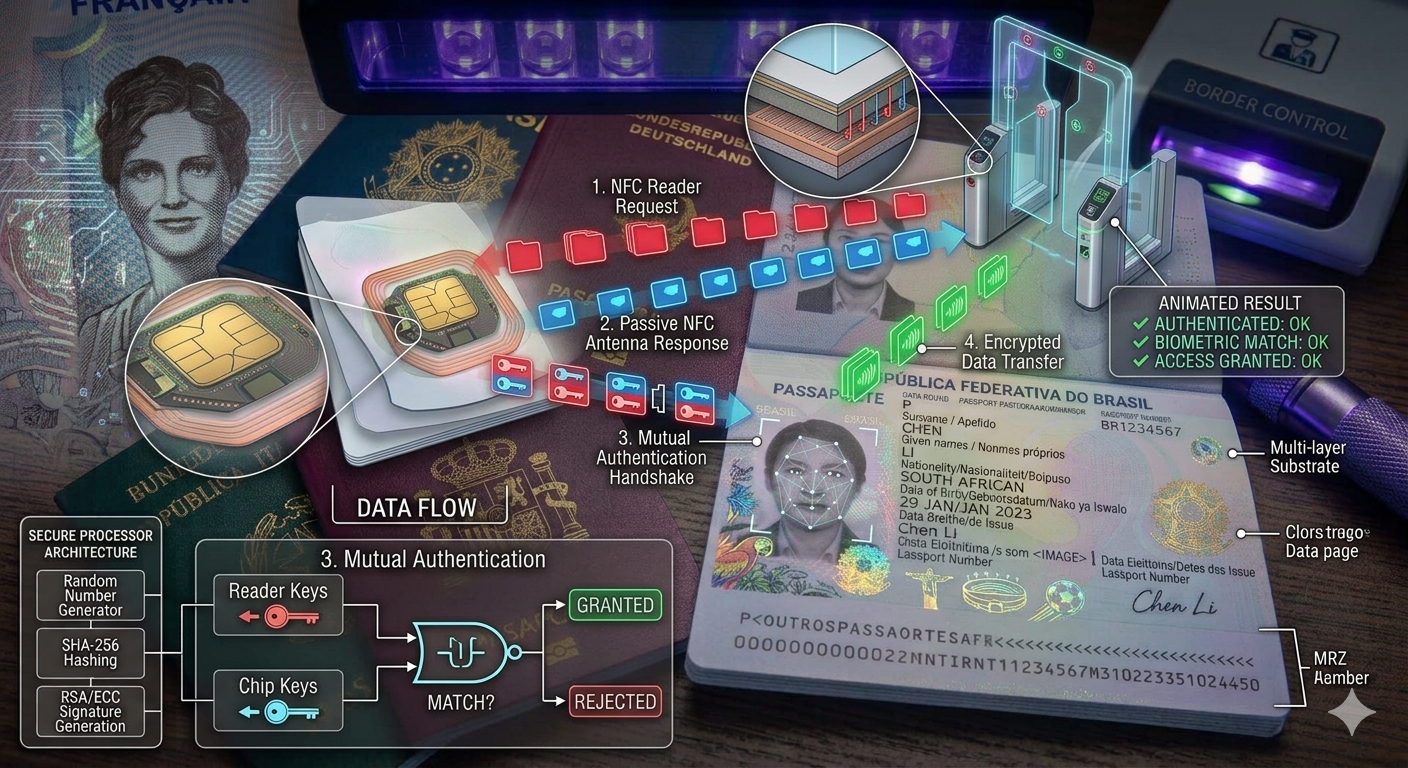
Advanced materials, precision printing, and cryptographic authentication work together to protect modern passports, but understanding what each security layer proves is essential when assessing fake passports, suspicious documents, and claims about cloned chips.
Modern passports are sophisticated security devices that combine specialized materials, intricate printing, protected personal information and, in electronic versions, cryptographic safeguards designed to make unauthorized reproduction and alteration much harder and easier to detect.
Their Protection depends on several connected layers rather than one supposedly unbeatable feature, because a convincing photograph, an impressive hologram or a readable electronic chip cannot independently establish that a document is genuine, valid and being presented by its rightful holder.
For travelers, businesses, and anyone researching how to identify a counterfeit passport, the central question is broader than appearance: whether the physical document, electronic information, issuing authority, and person presenting it form a consistent, verifiable identity record.
Why Passport Security Depends on Multiple Layers
A passport must perform several functions simultaneously: communicate identity, represent an issuing government’s certification, withstand repeated handling, and allow officials across jurisdictions to inspect its information using compatible procedures and appropriate equipment.
These demands explain why passport security extends beyond the booklet itself, incorporating the application process, production controls, document personalization, electronic authentication and subsequent checks that determine whether the document remains acceptable for its intended use.
ICAO’s specifications address security across design, manufacture and issuance, reflecting the principle that even an exceptionally well-protected booklet requires safeguards throughout the process that connects a verified applicant with a completed travel document.
Tamper Resistance Does Not Mean Automatic Detection
Describing passports as impossible to alter, or suggesting that every attempted modification instantly destroys their integrity in an obvious way, overstates what security engineering can guarantee and risks giving document holders an unjustified sense of certainty.
A more accurate description is that security features increase the difficulty of manipulation and provide opportunities to detect inconsistencies. At the same time, the outcome of an examination still depends on the document version, equipment, reference information, and checks actually performed.
For readers evaluating claims about fake passports, this distinction matters because neither dramatic assurances of perfect security nor sweeping claims that modern passports are easily defeated provide a reliable basis for judging a particular document.
From Security Paper to Polycarbonate Data Pages
Passport construction has evolved beyond the familiar Image of a printed photograph protected by a transparent covering, with some modern designs combining a durable polycarbonate personal-data page, specialized paper visa pages and an integrated electronic component.
The U.S. Department of State’s description of passport security identifies polycarbonate data pages, laser engraving, security fibers and perforated passport numbering among the features used in its next-generation passport book, first issued in 2021.
Why Polycarbonate Matters
Canada provides another documented example of this approach, describing a polycarbonate information page with laser-engraved personal details, along with additional visual features intended to protect the identity information carried within the passport and support document examination.
Practically, personal information becomes part of a deliberately engineered security structure, making the data page more than an ordinary printed surface and giving examiners additional features to assess when authenticity is questioned.
However, a rigid plastic page should never be a universal test of authenticity, because countries introduce designs at different times and legitimate documents can remain in circulation after a newer generation has appeared.
The United States explicitly confirms that its older passport designs remain usable for international travel when they are unexpired and undamaged, illustrating why unfamiliar construction should prompt a version-specific check rather than an immediate accusation of counterfeiting.
The Physical Security Features in a Passport
Passport security features can include protected printing, distinctive paper characteristics, integrated portraits, tactile elements, and optical effects. Still, you must assess the exact combination against the issuing country’s documented design rather than a generic internet checklist.
Official British guidance illustrates this variety by describing different features across successive passport generations, reinforcing the importance of identifying the correct version before deciding whether a particular page, portrait or protective element appears inconsistent.
Microprinting and Fine Detail
Microprinting places very small lettering within a document’s design, allowing magnified examination to reveal information that may be unavailable in a casual inspection or a compressed photograph sent via email or messaging service.
British document-examination guidance also contrasts the fine Background lines of genuine examples with the printing characteristics visible in counterfeit examples, showing why close examination can reveal differences that a normal-sized Image does not adequately communicate.
The sensible conclusion is not that every blurred character proves fraud, because an Image may be poorly focused or heavily compressed, but that any concern should be investigated using the original document and an appropriate reference wherever possible.
Watermarks, Tactile Features and Optical Effects
The European Union’s public document reference system, PRADO, recommends examining features through touch, direct observation and changes in viewing angle, with additional checks using transmitted light or magnification where relevant to the particular document being examined.
These techniques can help assess watermarks, raised printing, small lettering and features that change appearance when tilted, while also reminding examiners to compare the portrait with the holder and consider the document’s expiry and intended purpose.
For anyone conducting an initial review, the useful principle is to gather mutually supporting observations rather than treating a single attractive feature as decisive, especially when a seller or intermediary controls every photograph and demonstration being supplied.
What Ultraviolet Examination Can Establish
Ultraviolet examination can reveal security artwork and material responses that are not apparent under ordinary lighting, making it a useful part of document inspection when the examiner knows which features should appear in the relevant passport version.
Canada’s published passport information, for example, shows artwork that changes under ultraviolet illumination. At the same time, British guidance describes UV examination as one component of a broader process for recognizing potentially fraudulent identity documents.
A photograph of illuminated pages should therefore be treated as evidence about the features visible in that photograph, rather than proof that the issuing authority approved the passport, that its electronic information is authentic or that its bearer is entitled to use it.
This is particularly important in remote transactions, where a video may show a real document without establishing its connection to the recipient, and where a persuasive presentation can leave key questions about issuance and ownership unanswered.
NFC Chip Security: Reading Data Versus Authenticating It
An electronic passport adds a contactless chip to the physical security structure, enabling compatible readers to retrieve stored information and, when the necessary authentication checks are performed, evaluate protections that cannot be assessed from the printed page alone.
Canada explains that its passport chip contains the holder’s facial photograph and information corresponding to the data page. It clarifies that the facial Image is the only biometric stored in the Canadian passport chip.
A Successful Scan Is Only the Beginning
When discussing NFC chip security, the most important distinction is between a reader successfully communicating with the chip and a verification system establishing that its protected information has a valid cryptographic connection to the issuing authority.
ICAO describes a trust structure involving government signing certificates and document signatures, which allows an appropriately configured verification system to assess whether the electronic information is authentic and has remained unchanged since it was signed.
For a consumer reviewing an application result, this means that seeing a name, photograph and passport number on a screen answers a narrower question than receiving a documented authentication result that explains which security checks were completed successfully.
An application screenshot should therefore be accompanied by an explanation of its scope, particularly when the result supports a major financial decision, resolves an authenticity dispute, or demonstrates that a document is ready for international travel.
Digital Signatures Protect Data Integrity
Passive authentication verifies the signed passport data, while ICAO identifies additional mechanisms, including active authentication and chip authentication, that may be implemented to help detect substitution of the original chip with a copied electronic equivalent.
The implication is that “chip verified” is an incomplete description unless the reviewer knows what was verified, which trust information was available, and whether any applicable checks against chip copying were actually supported and performed during the examination.
What a Cloned Passport Claim Really Means
The phrase “cloned passport” can obscure several different allegations, including copied electronic data, duplicated images, or misuse of a genuine document, so an informed assessment should begin by identifying exactly what the person making the claim says was reproduced.
Historical WIRED reporting on an early electronic-passport cloning demonstration documented a 2006 example involving copied chip data, making it a useful historical reference without establishing that every current passport design can be defeated in the same way.
ICAO’s present explanation separates authentication of signed information from additional protections against cloning. Further, it emphasizes comparing authenticated electronic details with the printed document to identify discrepancies between the two sources of identity information.
For readers, the essential lesson is to avoid treating the word “clone” as a complete technical explanation, because copying information, changing authenticated information, and successfully impersonating the rightful holder are separate propositions that require separate evidence.
Why a Phone May Fail to Read a Passport Chip
An unsuccessful phone scan does not, by itself, establish that a passport is counterfeit, just as a successful scan does not independently prove that the document remains valid or that the person presenting it is its rightful holder.
Official Home Office design guidance recognizes that users may need help locating and scanning a passport chip. At the same time, ICAO explains that a document that fails to communicate with a reader may require further examination to determine the cause.
The appropriate response is to record the error, follow the reader’s documented instructions, and seek advice from the issuing authority when problems persist, rather than accept an unsupported explanation or attempt to modify the document.
Claims that a delivered passport requires a private seller to “activate” its government security features should be independently checked with the issuing authority, because a payment demand or reassuring message does not establish either the technical diagnosis or the document’s official status.
How to Identify a Counterfeit Passport Responsibly
Learning to identify a counterfeit passport begins with recognizing the limits of informal inspection, because a traveler or business employee can spot reasons for concern without the equipment, training, or authority needed to make a definitive forensic finding.
A responsible assessment asks whether the document matches its claimed version, whether the visible and electronic information agree, whether the person matches the identity and whether the available evidence supports lawful issuance and continued validity.
Match the Reference to the Document
Before comparing security features, identify the issuing country, document category and relevant generation, since a regular adult passport, an emergency document and a diplomatic passport may have different characteristics without those differences automatically indicating fraud.
PRADO provides public descriptions and illustrations selected by document specialists. Still, it also cautions that reproduced colors may differ from originals and that the published entries describe selected important features rather than every security element present.
This makes reference material a tool for structured comparison, not a substitute for professional examination, particularly when a disputed feature is difficult to photograph, or the available Image does not show enough detail for a reliable Judgment.
Separate Consistency From Authenticity
A document can display internally consistent information without answering every relevant question, so a report should explain whether it assessed an Image, the original booklet, electronic signatures, identity matching, or confirmation from an issuing authority.
For example, a finding that printed information is legible should not be presented as proof of government issuance, and a finding that an Image contains no detected alteration should not be expanded into a guarantee about the underlying physical passport.
Businesses commissioning verification should request clearly defined findings, stated limitations and an escalation process, because an unexplained pass-or-fail label can conceal substantial differences between a superficial review and a more comprehensive identity assessment.
Check Status Separately From Construction
INTERPOL’s Stolen and Lost Travel Documents database includes records of documents reported lost, stolen, revoked, invalid, or stolen blank, demonstrating why document status remains a separate question even when the physical booklet appears genuine.
A strong-looking passport should therefore never be assumed acceptable solely because its printing and chip appear intact, and a private verification provider should explain which status checks it can actually perform rather than implying unrestricted access to government systems.
Fake Passports and the Limits of Appearance
Public discussion often groups different forms of passport misuse together, but counterfeit manufacture, alteration of an existing document, impersonation, and obtaining a genuine document through false supporting information involve different weaknesses and require different investigative responses.
The U.S. Department of State identifies the use of false supporting documents, deceased persons’ identities, and stolen or altered passports among recognized forms of passport fraud, illustrating why examining the booklet alone cannot address every possible scenario.
For an organization assessing identity, the practical consequence is that document examination should be connected to a proportionate process for establishing who the person is, rather than allowing confidence in a security feature to replace the broader identity assessment.
This distinction also supports fair treatment of legitimate travelers, since an unfamiliar design, an old portrait, or an unsuccessful scan should trigger careful investigation rather than an automatic assumption that the holder has knowingly presented fake passports.
Dark Web Passport Claims Require Independent Evidence
Treat a “dark web passport” advertisement as an unverified sales claim, especially when it promises guaranteed border acceptance, immunity from investigation, or a supposedly official identity that cannot be confirmed through an independent government channel.
Screenshots, testimonials, sample documents and dramatic technical language do not resolve those questions, because none independently establishes that the seller has authority to arrange issuance or that the document offered corresponds to an approved and verifiable application.
A reasonable consumer-protection approach requires a clear explanation of the lawful process, the responsible authority, and the means of independent verification, while declining to treat secrecy or urgency as substitutes for evidence.
When an intermediary discourages contact with the issuing authority, demands further payment before allowing meaningful verification or repeatedly changes the explanation for a defect, the unresolved issue should remain unresolved until reliable evidence addresses it.
Protecting Passport Information During Verification
Passport security also depends on how personal information is handled after issuance, particularly when travelers send document copies to accommodation providers, professional advisers or verification services that may have different collection practices and retention arrangements.
Canada advises passport holders to share travel-document information only with trusted individuals or organizations and to contact the Passport Program when they suspect identity theft or fraudulent use of their identity in a travel-document application.
Before submitting a scan, consumers should establish why it is needed, who will receive it, and how to raise concerns. At the same time, organizations should request only the information necessary for their legitimate purpose and clearly explain how they handle it.
For readers exploring cross-border planning through Amicus International Consulting, independent verification should remain part of an informed decision, with clear documentation of the proposed process and no assumption that advisory involvement itself proves a passport’s authenticity.
What Reliable Passport Security Ultimately Requires
Modern passports bring together materials engineering, visual inspection, and electronic authentication. Still, their effectiveness depends on examining those protections correctly and linking them to reliable information about the issuing authority, document status, and the person presenting the booklet.
The most useful response to uncertainty is a precise question about evidence: what was inspected, what was authenticated, what remains unconfirmed, and which competent authority can resolve the outstanding issue before the document is relied upon.
Understanding those boundaries helps travelers avoid misleading promises, helps businesses describe verification honestly,y and keeps public discussion of NFC chip security, cloned passport allegations,s and counterfeit detection grounded in what the available evidence can actually establish.